In the equipment service industry, competitive advantage has shifted from who has the most machines to who has the most engaged technical workforce. With demand far outpacing supply and with 89% of dealers reporting a labor shortage, retention is no longer just an HR project. It is a boardroom strategic requirement. To win this battle for talent, leadership must move beyond competitive pay and embrace a high level cultural shift: the professionalization of the Technician Experience, or TX.
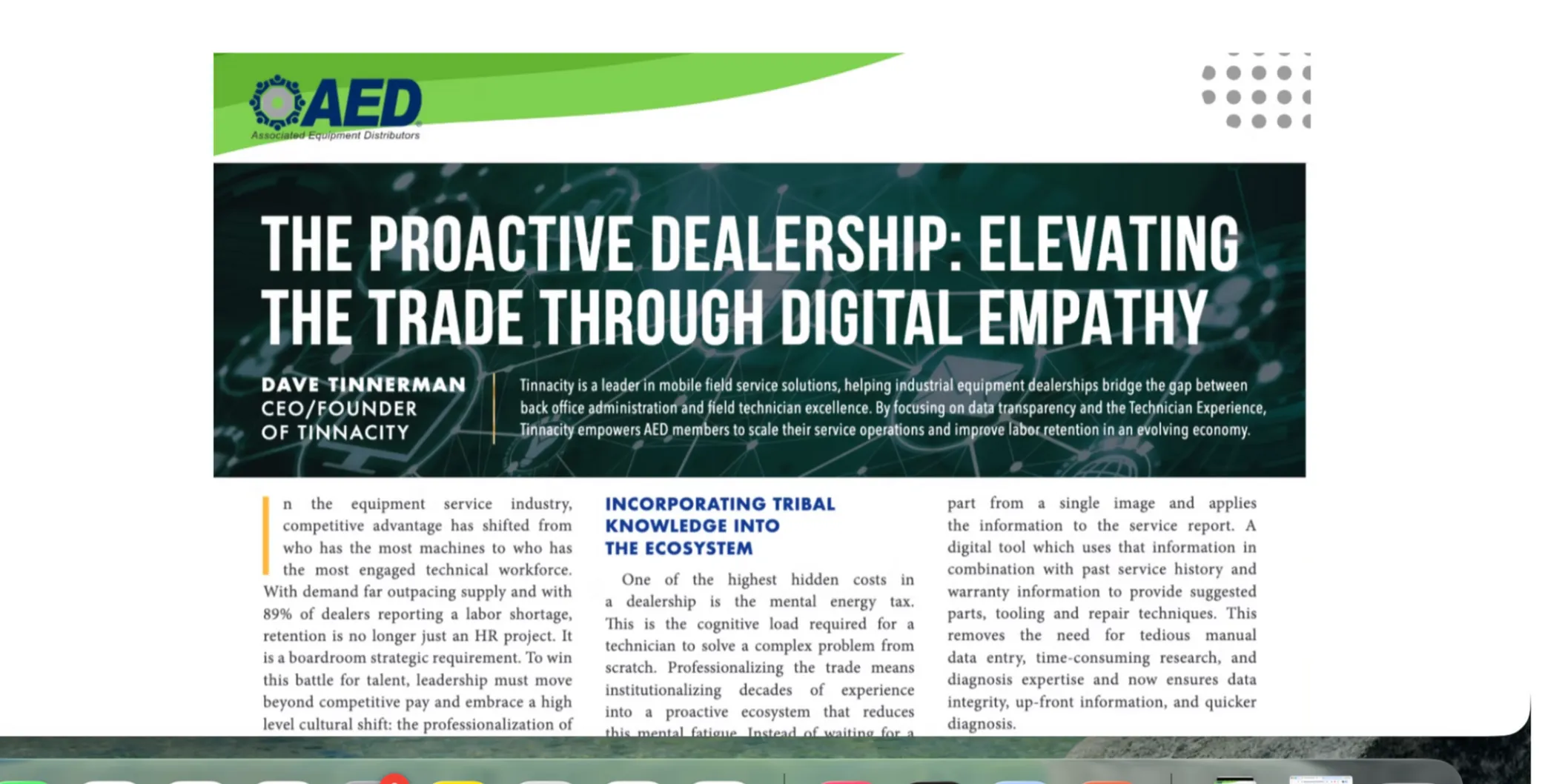
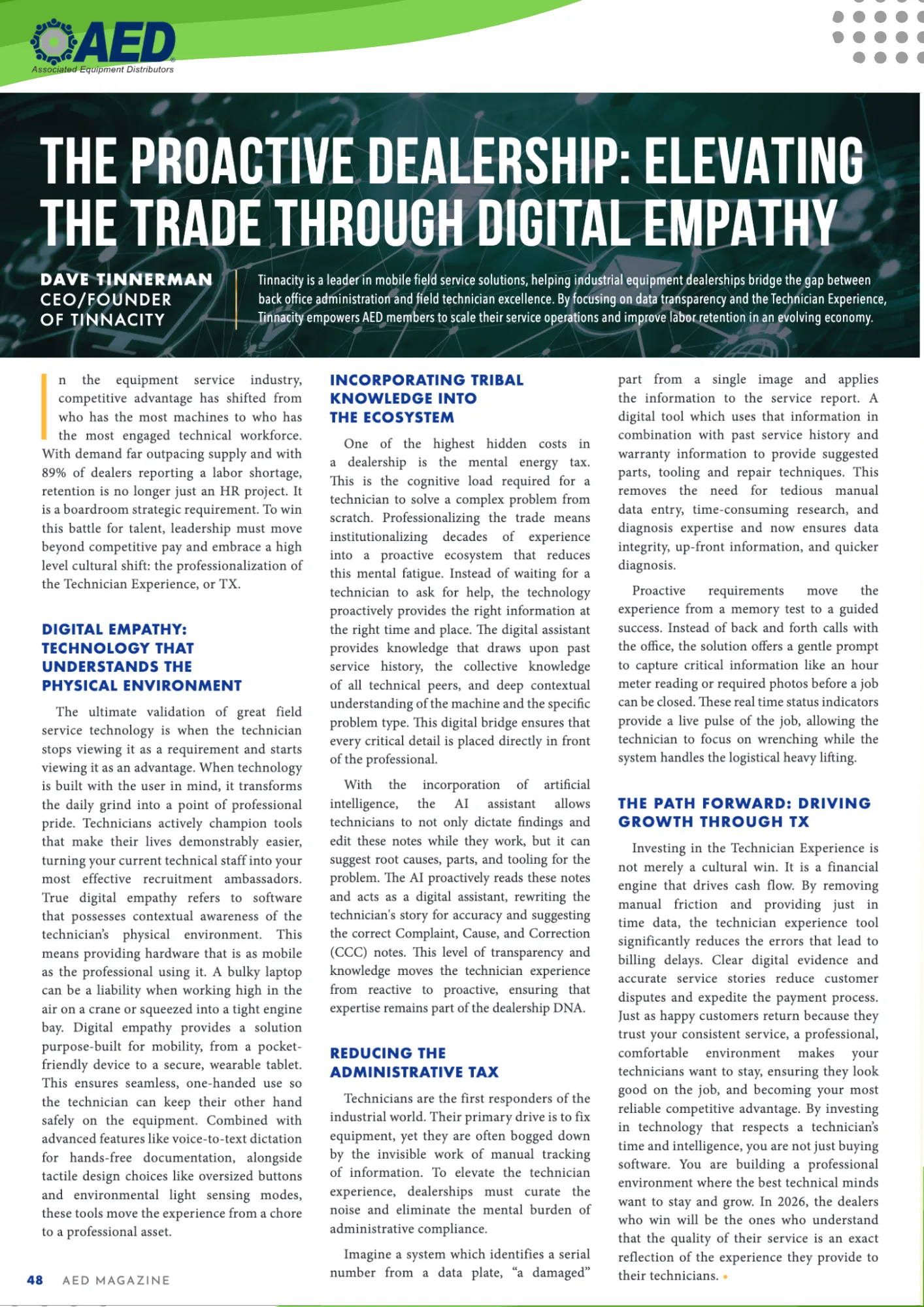
The proactive dealership: elevating the trade through digital empathy.
Tinnacity founder and CEO Dave Tinnerman's Letter from the CEO, published on page 48 of the April 2026 edition of AED Magazine, on why the Technician Experience is becoming the competitive advantage in equipment service.

Digital empathy: technology that understands the physical environment.
The ultimate validation of great field service technology is when the technician stops viewing it as a requirement and starts viewing it as an advantage. When technology is built with the user in mind, it transforms the daily grind into a point of professional pride. Technicians actively champion tools that make their lives demonstrably easier, turning your current technical staff into your most effective recruitment ambassadors.
True digital empathy refers to software that possesses contextual awareness of the technician's physical environment. This means providing hardware that is as mobile as the professional using it. A bulky laptop can be a liability when working high in the air on a crane or squeezed into a tight engine bay. Digital empathy provides a solution purpose-built for mobility, from a pocket-friendly device to a secure, wearable tablet. This ensures seamless, one-handed use so the technician can keep their other hand safely on the equipment. Combined with advanced features like voice-to-text dictation for hands-free documentation, alongside tactile design choices like oversized buttons and environmental light sensing modes, these tools move the experience from a chore to a professional asset.
Incorporating tribal knowledge into the ecosystem.
One of the highest hidden costs in a dealership is the mental energy tax. This is the cognitive load required for a technician to solve a complex problem from scratch. Professionalizing the trade means institutionalizing decades of experience into a proactive ecosystem that reduces this mental fatigue. Instead of waiting for a technician to ask for help, the technology proactively provides the right information at the right time and place. The digital assistant provides knowledge that draws upon past service history, the collective knowledge of all technical peers, and deep contextual understanding of the machine and the specific problem type. This digital bridge ensures that every critical detail is placed directly in front of the professional.
With the incorporation of artificial intelligence, the AI assistant allows technicians to not only dictate findings and edit these notes while they work, but it can suggest root causes, parts, and tooling for the problem. The AI proactively reads these notes and acts as a digital assistant, rewriting the technician's story for accuracy and suggesting the correct Complaint, Cause, and Correction (CCC) notes. This level of transparency and knowledge moves the technician experience from reactive to proactive, ensuring that expertise remains part of the dealership DNA.
Reducing the administrative tax.
Technicians are the first responders of the industrial world. Their primary drive is to fix equipment, yet they are often bogged down by the invisible work of manual tracking of information. To elevate the technician experience, dealerships must curate the noise and eliminate the mental burden of administrative compliance.
Imagine a system which identifies a serial number from a data plate, “a damaged” part from a single image and applies the information to the service report. A digital tool which uses that information in combination with past service history and warranty information to provide suggested parts, tooling and repair techniques. This removes the need for tedious manual data entry, time-consuming research, and diagnosis expertise and now ensures data integrity, up-front information, and quicker diagnosis.
Proactive requirements move the experience from a memory test to a guided success. Instead of back and forth calls with the office, the solution offers a gentle prompt to capture critical information like an hour meter reading or required photos before a job can be closed. These real time status indicators provide a live pulse of the job, allowing the technician to focus on wrenching while the system handles the logistical heavy lifting.
The path forward: driving growth through TX.
Investing in the Technician Experience is not merely a cultural win. It is a financial engine that drives cash flow. By removing manual friction and providing just in time data, the technician experience tool significantly reduces the errors that lead to billing delays. Clear digital evidence and accurate service stories reduce customer disputes and expedite the payment process. Just as happy customers return because they trust your consistent service, a professional, comfortable environment makes your technicians want to stay, ensuring they look good on the job, and becoming your most reliable competitive advantage. By investing in technology that respects a technician's time and intelligence, you are not just buying software. You are building a professional environment where the best technical minds want to stay and grow. In 2026, the dealers who win will be the ones who understand that the quality of their service is an exact reflection of the experience they provide to their technicians.
“In 2026, the dealers who win will be the ones who understand that the quality of their service is an exact reflection of the experience they provide to their technicians.”
Want More Like This?
Let's talk about what's next.
Questions about a feature, a client story, or what's coming down the roadmap? Our team's ready to talk.

Michael Simon
Sr. Sales Executive

Brady Fleming
Sales Executive

Brian Robison
Sales Engineer